Home → Episodes → Murder, A Self Portrait
Murder, A Self Portrait
Russian title: Гений и злодейство · Russian version
A celebrated painter kills his first wife's biographer to keep a decades-old secret buried, and the episode turns into the closest thing the series has to a psychological study of an artist.
Editor’s rating — 7.5 out of 10.
- Number
- 50 of 69
- Aired
- November 25, 1989
- Running time
- 88 min
- Director
- James Frawley
- Writer
- Robert Sherman
The case
- The killer
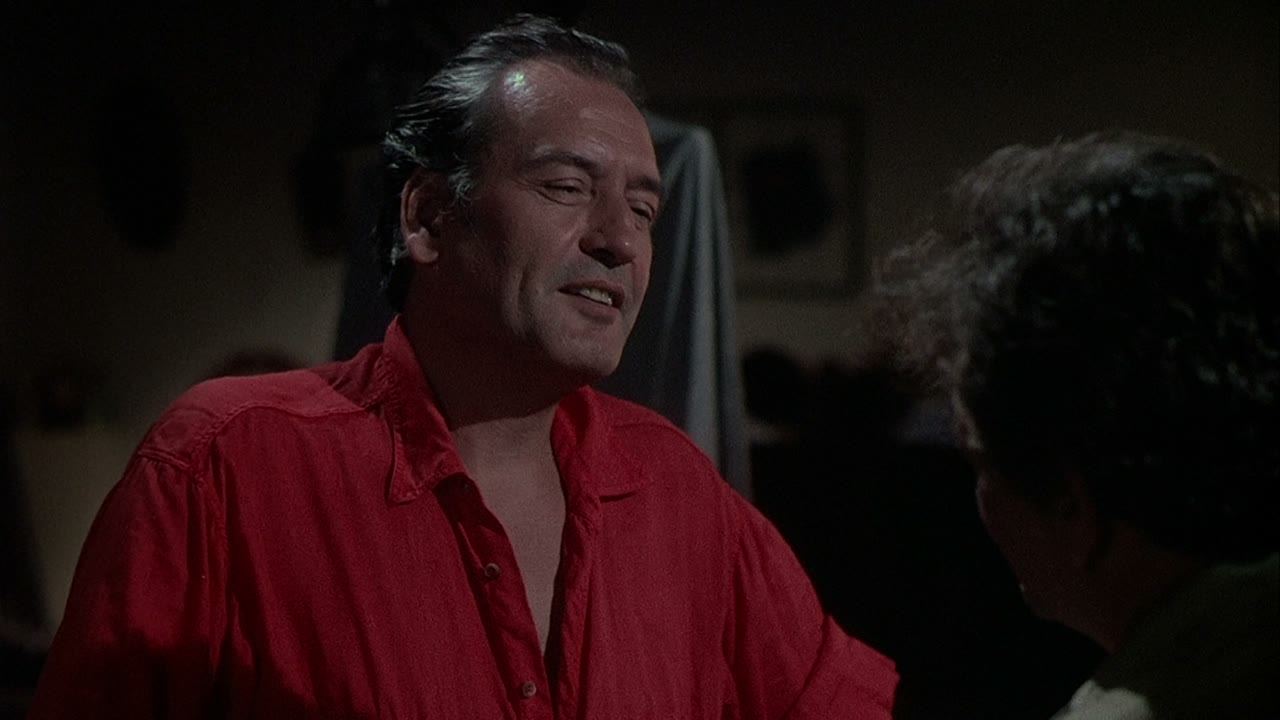
- Patrick Bauchau as Max Barsini
- The victim
- Fionnula Flanagan as Louise Barsini; Harold Harris as Harry Chudnow
- Guest cast
- Patrick Bauchau, Fionnula Flanagan, Shera Danese, Danny Hassel, Isabel García Lorca, George Coe
Columbo is an inverted mystery: the murder opens the film and the killer is known from the first minutes. What you are watching for is how he proves it — see how the character works.
The murder
Max Barsini is a famous painter living comfortably between a wife, a mistress and a first wife he has never quite discarded. Louise, the first wife, has been in analysis, and her therapist Dr Herzog has learned something about a death years earlier that Barsini cannot afford to have told.
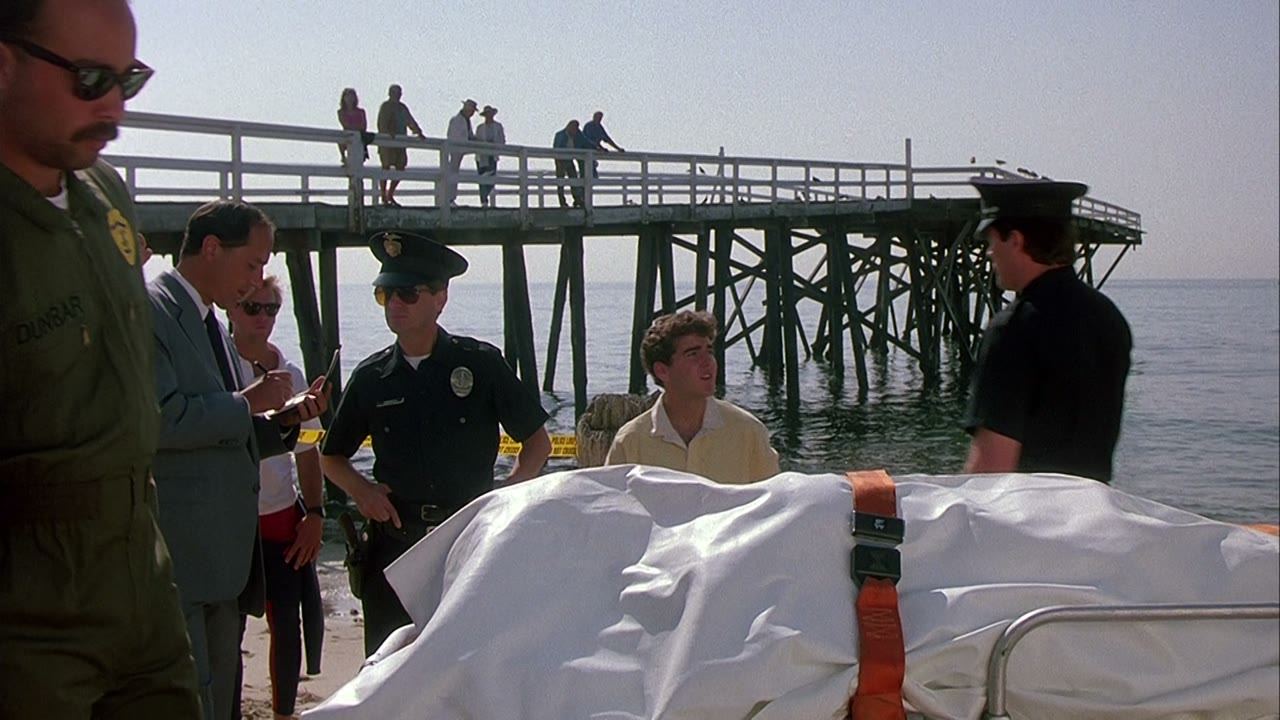
He kills Herzog and stages a drowning, using his own knowledge of the coastline and the tides. The body is expected to be read as an accident by a man who swam where he should not have.
The secret being protected is the point: Barsini's reputation as a great artist depends on a version of his own past that is not true.
The household arrangement is the film's first surprise: Barsini lives with his second wife Vanessa, keeps his first wife Louise in a cottage on the property, and paints his mistress. Everyone knows about everyone, and the arrangement has held for years on the strength of his charm.
What destabilises it is therapy. Louise has been in analysis, and under it she has begun to recover a memory of a death — a woman who drowned years ago, in circumstances Barsini has always described as an accident.
Dr Herzog, her analyst, comes to the house to talk about it. Barsini drowns him and puts the body into the sea at a point where the tide should carry it away from anything that matters.
How Columbo gets him
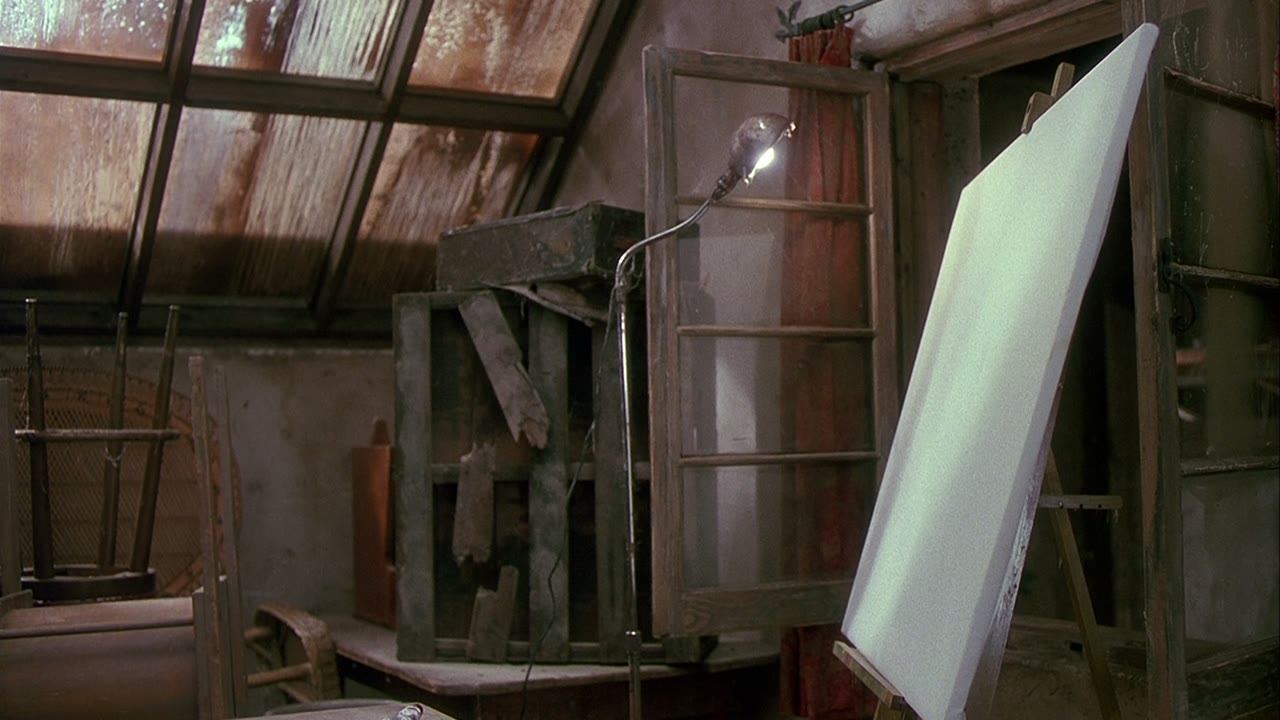
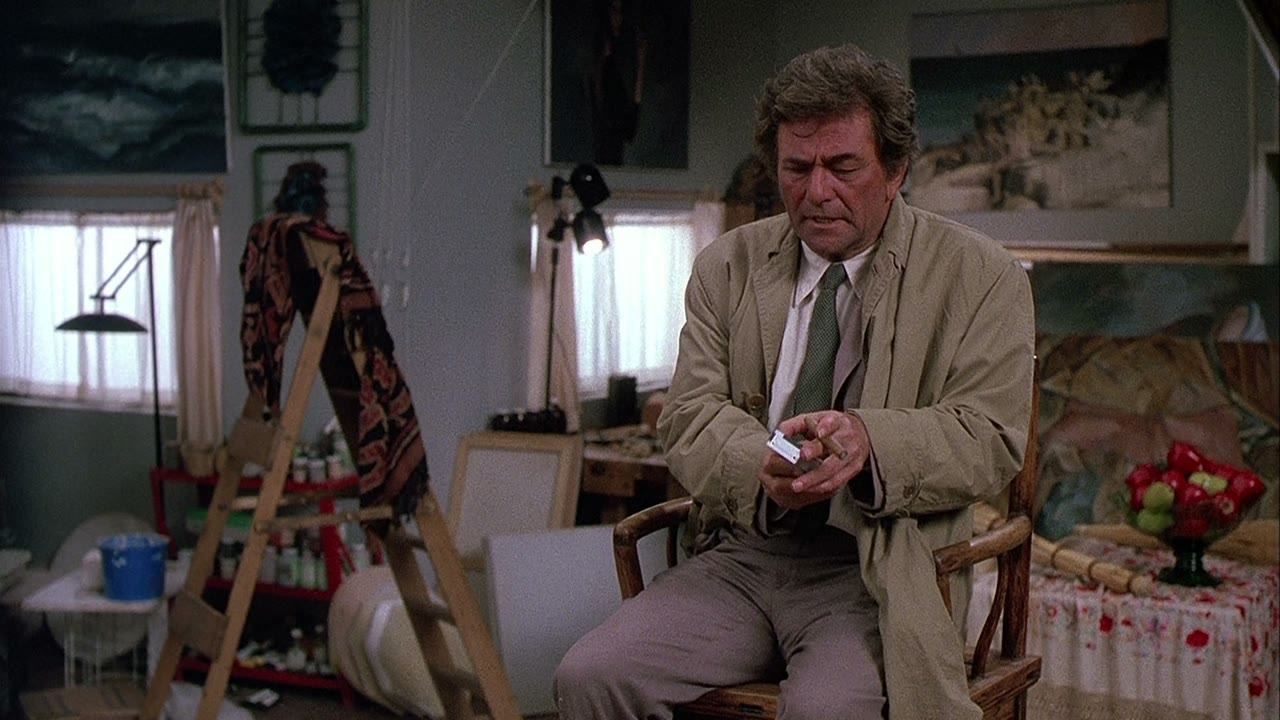
The episode spends a great deal of time in Barsini's studio, and Columbo, who knows nothing about painting, asks the questions an art critic would never ask — about how long things take, about what gets painted over, about who cleans the brushes.
The forensic line is the tide. A body that entered the water at one point cannot be recovered at another without a current that was not running that night.
The resolution comes through the paintings themselves. Barsini has painted the truth more than once without meaning to, and Columbo — with help — reads the canvases as evidence.
The studio scenes are the substance of the episode. Columbo, who knows nothing about painting, asks how long a canvas takes, what happens to the ones that fail, and whether an artist ever paints over his own work. Barsini answers all of it happily, because nobody has been that interested in the mechanics for years.
The tidal evidence is unusually technical for the series — where a body enters the water and where it comes ashore are related by currents that can be reconstructed, and the reconstruction puts the entry point at Barsini's own stretch of coast.
Louise is the moral centre. She is fragile, has been managed for decades, and is the only person in the film with nothing to gain from lying. Her recovered memory is treated as evidence rather than as symptom, which is what the psychiatrist in A Deadly State of Mind counted on nobody doing.
Worth knowing
- Patrick Bauchau plays Barsini with a European looseness that makes the self-mythologising convincing.
- The episode features one of the longest single conversations in the run — a studio scene of nearly ten minutes.
- Directed by James Frawley; the art was produced by a working painter hired for the production.
- The paintings were produced by an artist hired for the production, including the overpainted canvas that resolves the plot.
- Patrick Bauchau was primarily a European art-house actor, which gives Barsini's self-mythologising an authenticity American casting would have struggled with.
- At 98 minutes it is one of the longest films in the run, and the pace is deliberate throughout.
Verdict
Slow, and better for it. This is one of the few later episodes that is genuinely about something — the difference between an artist's work and the story he tells about it.
The overpainted canvas is also one of the most elegant clues of the ABC years: the evidence was hanging on a wall the whole time.
The best of the early ABC films after Agenda for Murder, and the one that most resembles the classic era in temperament: a murderer with a real interior life, a motive about identity rather than money, and a clue that has been visible on a wall the entire time.
What the people who made it said
The painter was modelled on Picasso — and not only as a painter: by the late eighties the press was going through his biography and his treatment of women.
“The villain was based on Pablo Picasso, who was the world's best-known abstract artist — but also, at the time the episode was made, he was in the news: they were digging up his past and discovering that he was an extremely abusive womanizer.”
They decided against making him an abstract painter: he had to produce portraits — of his wife, and later of Columbo. What they made abstract instead was the film itself.
“Their thought was: let's make the whole episode abstract rather than just the painter — and make the clues abstract.”
Quotes are in the speaker’s own words — from a transcript of the recording, or from the printed source. Players open at the right minute. Everything is shortened; the full version is in the source.
Familiar faces
Actors who turn up in the series more than once — sometimes in very different parts.
- Shera Danese as Vanessa Barsini 6 episodes also in Fade in to Murder, Murder Under Glass, Columbo and the Murder of a Rock Star, Undercover, A Trace of Murder
- Vito Scotti as Vito 6 episodes also in Any Old Port in a Storm, Candidate for Crime, Swan Song, Negative Reaction, Identity Crisis
- David Byrd as Ralph 2 episodes also in No Time to Die
- Lenny Hicks as Morgue Attendant 2 episodes also in Columbo Goes to the Guillotine
- Jean-Paul Vignon as Maitre d' 2 episodes also in Rest in Peace, Mrs. Columbo
Cast data from TMDB, including uncredited bit parts. All the familiar faces →